
Expert-reviewed by Dr. Kristyn VanDahm
Apr 24, 2026
How Do You Know If a Kids' Show Is Actually Good?
We evaluate every show on 7 developmental domains. Here's the framework, and what parents should actually look for.
The Framework Behind Maka
Every parent has heard the same advice: limit screen time. But very few have ever been told what good screen time actually looks like — or what matters beyond the amount of minutes.
The truth is, the research doesn't just say "less is more." It says quality matters enormously. High quality media can support a child's emotional development, build vocabulary, teach empathy, and reinforce the habits and values that parents are working hard to nurture every day.
The problem is that until now, parents haven't had a clear, accessible standard for evaluating what's actually happening in the shows their children watch. Is this episode modeling resilience, or just filling kids’ time? Does this character encourage emotional regulation, or blow past it? What kinds of content are developmentally supportive for a 3-year-old vs. a 6-year-old?
That's exactly what Maka Imprint was built to evaluate.
What Is Maka Imprint?
Maka Imprint is a proprietary developmental evaluation framework built over two years of rigorous research and development, in collaboration with researchers from Yale Child Study Center. Maka uses Imprint to evaluate every piece of children's media in our app, Maka Kids. We assess not just what a show is about, but what it actually teaches, models, and reinforces for children at specific developmental stages.
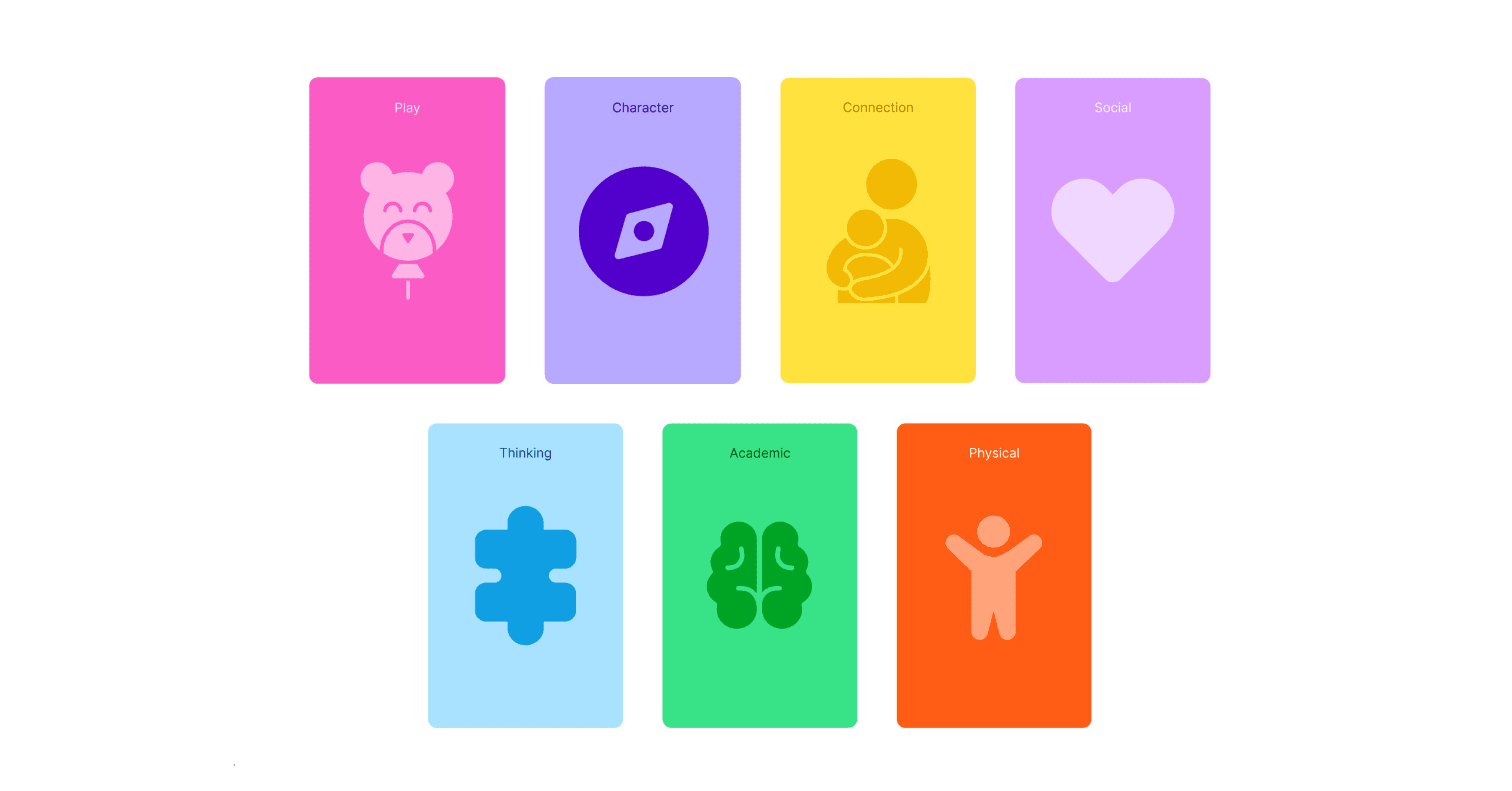
At its core, Imprint maps seven core developmental domains across the full arc of early childhood, from infancy through early elementary school. Each domain is grounded in peer-reviewed research and broken down into age-specific behavioral milestones — so that Maka can evaluate content with precision. This means parents can trust in the quality of the Maka Kids catalog.
The result is a streaming platform where every show is backed by developmental science, not just to maximize watch time or engagement.
About this framework: Maka Imprint was developed under the academic leadership of Tanyella Leta, M.Ed. (Harvard University, Human Development), in formal collaboration with Dr. Nancy Close, PhD, and Dr. Linda Mayes, MD, of the Yale Child Study Center. The framework draws methodologically on the Harvard Graduate School of Education EASEL Lab's taxonomy-based approach to social, emotional, and cognitive development, and on clinical developmental milestone frameworks recommended by Yale. Additional research support was provided by Maria Casas, M.Ed. (Harvard University) and Maisha Hossain, MRes (Developmental Neuroscience and Psychopathology, UCL / Yale Child Study Center). All domain definitions, milestones, and evaluation criteria are grounded in peer-reviewed developmental science and have been reviewed by Dr. Kristyn VanDahm, PhD.
The Seven Core Developmental Domains
Maka Imprint organizes child development into seven interconnected domains. Together, they represent the full scope of how a growing child is developing — cognitively, emotionally, socially, and physically — and serve as a lens to assess what high-quality media can meaningfully support.
1. Thinking
Thinking, as defined by Maka Imprint, encompasses two tightly connected areas: executive function and cognitive development. Executive function refers to the foundational set of processes — working memory, attention control, and cognitive flexibility — that support goal-directed behavior, problem-solving, and self-regulation. Cognitive development covers how children build understanding of the world through reasoning, concept development, categorization, cause-and-effect, and early logical thinking.
The Thinking domain was derived from the EASEL Lab's Executive Function Mapping Project (Jones et al., 2016), a large-scale synthesis across approximately 160 studies in developmental psychology, neuroscience, and education. These capacities emerge loosely at 12 months and expand rapidly between ages 3 and 5, when children begin developing capacities for self-regulation, planning, and following multi-step instructions.
What we look for in media that supports Thinking:
- Attentional control: Pausing and wait times, talking directly to the child viewer through the screen or breaking the fourth wall (e.g., “what do you think?”), zooming in with the camera to the object being spoken about
- Working memory: Repeating words and phrases said before (recall), asking the child viewer directly to remember a previous action, sequencing steps together (e.g. "first we did this", "next we did this")
- Cognitive flexibility: Trying different approaches (using contrastive language, e.g. "instead," "but now")
- Cognitive development (mainly categorization and critical thinking): Matching and sorting activities which are explained, reasoning their actions or decisions (using "because," "if we do this..," "so"), reflective processes (e.g. "I think next time I will..." or “I wonder…”), thinking about parts and the whole and how they fit together
2. Play
The Play domain encompasses imaginative play and creativity — from peek-a-boo with an 8 -month-old to collaborative world-building among 6-year-olds. It is one of children's primary modes of learning, and contributes to how they develop language, social understanding, emotional processing, and flexible thinking. Play is not incidental to development; it is central to it.
The Play domain was derived from developmental psychology research linking symbolic play to cognitive flexibility, emotional processing, and social development, with key sources including Biber (1951), Singer, Golinkoff & Hirsh-Pasek (2006) and Russ (2014).
What to look for in media that supports Play:
- Pretend play: Driven by the character’s own imagination, collaborative storytelling, open-ended problem solving, and modeling of caregivers who join play without redirecting it
- Creativity: Teaching lessons through an imaginative storyline
- Playfulness: Playing games together, dancing and singing, and characters showing that they want to have fun
- Symbolic play: Taking on different roles and identities, creating new and imaginary worlds and rules, using objects for different purposes (e.g. a stick of asparagus becomes a magic wand)
3. Connection
The Connection domain captures the everyday exchanges — verbal, physical, and emotional — through which children experience safety, belonging, and trust. Responsive, attuned, and sensitive relationships with caregivers are critical to healthy early development; they set the standard for what children can expect from others. They shape how children learn to regulate emotion, acquire language, navigate stress, and form their sense of self.
The Connection domain was derived from research curated by Dr. Nancy Close, PhD, of the Yale Child Study Center focused on attachment theory (Bowlby, 1969; Ainsworth, 1970), and relational frameworks including parental reflective functioning (Luyten et al., 2017; Sadler et al., 2013; Slade, 2005), co-regulation and security (Hoffman, Marvin, Cooper, & Powell, 2006; Li et al., 2017). The domain highlights a caregiver’s effect on the developing caregiver-child relationship, and child development. Crucially, this relationship doesn't require perfection — it requires sensitivity, delight, support for exploration, acceptance when frightened or stressed, responsiveness and repair. When caregivers notice disconnection and reconnect, children build resilience and trust.
What to look for in media that supports Connection:
- Repair: Adults who kneel to eye level and mirror a child's emotions, caregivers who name feelings without dismissing them, and moments of reconnection after conflict
- Being With: Caregivers who recognize and honor all feelings rather than denying them
- Physical affection: Caregivers who hold hands when children are feeling scared, caregivers who offer hugs and close contact during a moment of repair or when the child has big feelings
- Communication: Adults reflecting on children’s depth of thinking or feeling to expand their understanding, reaffirming something the child has said, and modelling how to express a feeling
- Emotional connection: Adult characters praising the child for their efforts or empathizing with how a child may feel
4. Character
The Character domain encompasses three deeply related areas: Perspectives (the ways children view and approach the world), Values (understanding of right and wrong, respect for others, responsibility, and social conventions), and Identity (the ways children perceive themselves and develop who they are).
These domains were derived from what Jones et al. (2021) describe as the broader belief ecology that surrounds and shapes children's skills — foundational orientations that influence how cognitive, social, and emotional competencies are expressed over time.
What to look for in media that supports Character:
- Values: Characters who notice fairness, persist in trying new and hard activities, show independence, stand up for others
- Perspectives: Characters who express optimistic thinking and a flexible attitude when faced with challenges, who are curious about new ideas, who notice beauty and value in everyday experiences, and who are developing empathy
Identity: Characters who see challenges as opportunities for growth, set goals, reflect on mistakes, show kindness to themselves, express confidence in their own abilities, and are supported in understanding — not just corrected
5. Academic
The Academic domain is about building the conceptual foundations that support later learning. Language development begins at birth, through cooing, babbling, and back-and-forth vocal exchanges, and rapidly expands through learning words, understanding stories, and being able to converse. Early math and science emerge through sorting, counting, cause-and-effect exploration, and observation — long before formal instruction begins.
When evaluating content through the Academic domain lens, Maka Imprint was informed by state curriculum standards and educationally-informed academic milestones (Heroman, Dodge, Berke & Bickart, 2010) — with key sources including Massachusetts Curriculum Framework for English Language Arts and Literacy (Massachusetts Department of Elementary and Secondary Education, 2017a), Mathematics (Massachusetts Department of Elementary and Secondary Education, 2017b) and Science and Technology Engineering (Massachusetts Department of Elementary and Secondary Education, 2016).
What to look for in media that supports Academic:
- Language: Characters who tell stories and label objects, produce phonics sounds and connect them to letters of the alphabet, teach sight words, describe the meaning of words, repeat and follow instructions to show that they understand
- Science: Characters who make and test predictions, name their observations, use their senses to explore, explain scientific processes using visual models, interpret evidence using “because,” name scientific facts, show genuine surprise and enthusiasm for what they discover
- Math: Characters who sort and count objects, measure and compare objects by dimensions like size, weight and length, identify shapes and describe their properties, solve simple operations (e.g. addition, subtraction)
6. Physical
The Physical domain encompasses gross and fine motor skills, body awareness, sensory exploration, coordination, and the daily living skills — toileting, hygiene, rest, and nutrition — that support lifelong well-being. It begins with an infant kicking their legs and following a moving object with their eyes, and progresses through walking, climbing, cutting with scissors, writing, and caring for their own bodies independently, like when brushing teeth.
The Physical domain was grounded in pediatric and clinical developmental milestone frameworks recommended by Dr. Nancy Close and Dr. Linda Mayes of the Yale Child Study Center, including the Developmental Milestones Table from the AAP’s Pediatrics in Review (Scharf, Scharf, Stroustrup, 2016). These sources document typical trajectories of gross motor, fine motor, and sensorimotor development and ensure that indicators reflect developmentally expected and observable physical behaviors.
What to look for in media that supports Physical:
- Body Awareness: Characters who recognize and label body parts, who use their body in motion
- Fine Motor Skills: Characters who focus on modeling grasping, hand-eye coordination (e.g. drawing, writing)
- Gross Motor Skills: Characters who focus on modeling whole body movements (e.g. dancing, jumping), balance, and exploring the physical world actively rather than with passivity
- Daily Living Skills: Characters who practice self-care with growing independence, and can sequence daily tasks
7. Social
The Social domain includes both the social and emotional development of children. Emotional development covers how children learn to recognize, express, and regulate their own feelings. Social development covers how children build relationships, navigate peer dynamics, develop empathy, develop perspective taking, and find belonging with peers. Both trajectories follow a clear arc from infancy through early elementary — and both can be shaped by the media children consume (Singer & Singer, 1998).
This domain was derived from the EASEL Lab's articulation of cognitive, social, and emotional skills as interrelated competencies (Jones & Bouffard, 2012; Jones et al., 2021) that develop dynamically and are shaped by instructional, relational, and contextual factors — including media.
What to look for in media that supports Social:
- Social: Characters who take turns and contribute to shared goals and group activities, who provide support and encouragement to friends, who collaborate with others in their behaviors and in conversation, who navigate exclusion and inclusion with adult guidance, and show that conflict followed by repair is normal and healthy
- Emotional: Characters who name emotions, express their feelings visually and verbally, regulate emotions with adult guidance and support, recognize others’ emotions and offer comfort
How Maka Imprint Works in Practice
Each video that appears on Maka Kids is evaluated against the Imprint's domain framework. Maka Imprint contains indicators to watch out for in shows to ensure they can be meaningfully identified through narrative, representation, and themes. Maka then evaluates content through these indicators.
Maka's AI model assesses content against Maka Imprint to determine how each video supports development through its scenes. There is, and always will be, a human child development researcher in the loop.
The evaluation process distinguishes between content that merely features a domain (a brief mention of sharing, say) versus content that drives the narrative through it (an episode centered on what fairness actually looks like when friends disagree). This distinction is what separates truly developmentally rich media from content that simply gestures at good values.
The result is a content layer invisible to children but profoundly useful to parents: a playlist built on the knowledge that what a child is watching is not just entertaining, but genuinely working in service of their development.
What This Means for Your Child's Viewing Experience
Most parents already sense when a show is good (or bad) for their kid. Maka Imprint just gives that instinct a language — and a little more to work with, for example:
- A show that consistently models emotional repair after conflict is doing something meaningful for a 4-year-old's developing social relationships.
- An episode where a character tries, fails, and tries again with a different strategy is modeling the same growth mindset that process-focused feedback from a caregiver builds.
Watching shows, at its best, can be an extension of the connection that's so critical to healthy development. Co-viewing — watching together and asking questions and sharing reflections— amplifies every domain. Research highlights the importance of adult mediation as a key mechanism of children's learning from media (Hirsh-Pasek et al., 2015; Strouse, Troseth, O'Doherty, & Saylor, 2018).
Frequently Asked Questions
Does Bluey support executive function?
When evaluated against Maka Imprint, Bluey episodes routinely rank high across domains. Many episodes show characters working through problems, shifting strategies when something doesn't work, and receiving adult scaffolding when they get stuck.
How can kids TV support social-emotional learning?
Social-emotional learning can be supported by content that models how children recognize and regulate emotions, build relationships, navigate peer dynamics, and develop empathy. Maka places these in the Social domain, and when evaluating content, we look for characters who name emotions, check in on others, and show that conflict followed by repair is normal and healthy.
How do I evaluate kids' TV shows for developmental value?
Maka Imprint is a practical starting point. Across any show, look for characters who face real obstacles and work through them with adult support, model emotional regulation, engage in open-ended play, and are shown building — not just displaying — skills like fairness, empathy, and persistence. Maka evaluates all content on the platform against these criteria so parents don't have to do this work themselves.
What makes children's media developmentally supportive?
Developmentally supportive media drives the narrative explicitly through a developmental domain, rather than merely featuring it. For example, an episode that centers on what it actually looks like to repair a friendship after a conflict is developmentally richer than one where a character simply says "sharing is caring." Maka evaluates content specifically with that distinction in mind.
What age range does the Maka Imprint cover?
Maka Imprint maps developmental milestones from birth through early elementary school (approximately ages 0-8), with age-specific behavioral anchors at each stage. Each domain includes indicators relevant to infancy, toddlerhood, preschool, pre-K, kindergarten, and early grades.
The Research Behind Maka Imprint
Maka Imprint was developed over two years of rigorous research and development in formal collaboration with researchers from Yale Child Study Center, under the oversight of Dr. Nancy Close, PhD, and Dr. Linda Mayes, MD. The framework draws methodologically on the Harvard Graduate School of Education EASEL Lab's taxonomy-based approach to social, emotional, and cognitive development. Every domain definition, milestone, and evaluation criterion is grounded in peer-reviewed developmental science.
Thinking
- Jones, S. M., Bailey, R., Barnes, S. P., & Partee, A. (2016). Executive Function Mapping Project: Untangling the terms and skills related to executive function and self-regulation in early childhood (OPRE Report No. 2016-88). Office of Planning, Research and Evaluation, Administration for Children and Families, U.S. Department of Health and Human Services.
Play
- Biber, B. (1951). Play as a Growth Process. Vassar Alumnae Magazine, 37 (2). Retrieved from https://educate.bankstreet.edu/thinkers/9
- Russ, S. W. (2014). Pretend play in childhood. American Psychological Association.
- Singer, D. G., Golinkoff, R. M., & Hirsh-Pasek, K. (2006). Play = learning. Oxford University Press.
Connection
- Ainsworth, M. D. S., & Bell, S. M. (1970). Attachment, exploration, and separation: Illustrated by the behavior of one-year-olds in a strange situation. Child Development, 49-67.
- Bowlby, J. (1969). Attachment and loss: Vol. 1. Attachment. New York, NY: Basic Books.
- Hoffman, K. T., Marvin, R. S., Cooper, G., & Powell, B. (2006). Changing toddlers' and preschoolers' attachment classifications: The Circle of Security intervention. Journal of Consulting and Clinical Psychology, 74(6), 1017–1026. https://doi.org/10.1037/0022-006X.74.6.1017
- Li, J., Harvard University. (2017). Simple Interactions Tool: Coding framework for adult-child video Interactions. Junlei Li Lab, Harvard University.
- Luyten, P., Mayes, L. C., Nijssens, L., & Fonagy, P. (2017). The Parental Reflective Functioning Questionnaire - Adolescent version. University of Leuven, Belgium.
- Sadler, L. S., Slade, A., Close, N., Webb, D. L., Simpson, T., Fennie, K., & Mayes, L. C. (2013). Minding the baby: Enhancing reflectiveness to improve early health and relationship outcomes in an interdisciplinary home‐visiting program. Infant Mental Health Journal, 34(5), 391-405.
- Slade, A. (2005). Parental reflective functioning: An introduction. Attachment & Human Development, 7(3), 269-281.
Character
- Jones, S. M., & Bouffard, S. M. (2012). Social and emotional learning in schools: From programs to strategies. Social Policy Report, 26(4), 1–33. Jones, S. M., et al. (2021). Navigating social and emotional learning from the inside out (2nd ed.). EASEL Lab, Harvard Graduate School of Education.
Academic
- Clements, D. H., & Sarama, J. (2011). Early childhood mathematics intervention. Science, 333(6045), 968–970.
- Heroman, C., Dodge, D. T., Berke, K., & Bickart, T. (2010). Teaching Strategies GOLD® objectives for development & learning: Birth through kindergarten. Teaching Strategies, LLC.
- Linebarger, D. L., & Walker, D. (2005). Infants' and toddlers' television viewing and language outcomes. American Behavioral Scientist, 48(5), 624–645.
- Linebarger, D. L., & Vaala, S. E. (2010). Screen media and language development in infants and toddlers. Developmental Review, 30(2), 176–202.
- Massachusetts Department of Elementary and Secondary Education. (2017a). Massachusetts English Language Arts and Literacy Framework. http://www.doe.mass.edu/frameworks/ela/2017-06.pdf
- Massachusetts Department of Elementary and Secondary Education. (2017b). Massachusetts Mathematics Framework. https://www.doe.mass.edu/frameworks/math/2017-06.pdf
- Massachusetts Department of Elementary and Secondary Education. (2016). Massachusetts Science and Technology Engineering Framework. https://www.doe.mass.edu/frameworks/scitech/2016-04.pdf
Physical
- Scharf, R.J., Scharf, G.J., Stroustrup, A. (2016). Developmental Milestones. Pediatrics In Review, 37 (1): 25–38. https://doi.org/10.1542/pir.2014-0103
Social
- Jones, S. M., & Bouffard, S. M. (2012). Social and emotional learning in schools: From programs to strategies. Social Policy Report, 26(4), 1–33.
- Jones, S. M., et al. (2021). Navigating social and emotional learning from the inside out (2nd ed.). EASEL Lab, Harvard Graduate School of Education.
Other
- Strouse, G. A., Troseth, G. L., O'Doherty, K. D., & Saylor, M. M. (2018). Co-viewing supports toddlers’ word learning from contingent and noncontingent video. Journal of Experimental Child Psychology, 166, 310-326.
- Hirsh-Pasek, K., et al. (2015). Putting education in "educational" apps. Psychological Science in the Public Interest, 16(1), 3–34.
All research cited in Maka Imprint has been reviewed by our team of child development experts, including Maka’s Director of Research and Development, Dr. Kristyn VanDahm.
Join the Waitlist
Maka Kids is a kids streaming iOS app where every recommendation is evaluated through Imprint’s developmental framework. Parents can trust that the content their children love is also supporting their development.
Be one of the first to access it in the signup form below.